

Records - Built To Be Broken
Some Commonwealth Games records barely survive 24 hours, let alone a single Games cycle. Others have stood across generations. The contrast between them reveals how differently sports evolve.
At Birmingham 2022, records fell at pace. In the pool, Ariarne Titmus broke three records at a single Games, setting new marks in the 400m, 200m and 800m freestyle. Kaylee McKeown broke the 100m and 200m backstroke records. Lara van Niekerk broke her own 50m breaststroke record in qualifying, then lowered it again in the final.
In the velodrome, New Zealand's men set a new 4000m team pursuit record, Daniel Bigham broke the individual pursuit mark, and records fell in both the men's and women's team sprint. Sixty-nine current Commonwealth Games records across Swimming, Athletics, Cycling and Weightlifting were set in Birmingham alone.
In Swimming the pattern of rapid turnover is clearest. The men's 4x100m medley relay record has been broken at six consecutive Games. The women's backstroke records, the freestyle relays and the breaststroke events have all been updated repeatedly across the modern era. The professional systems, sports science and depth of competition across Commonwealth swimming keep driving times down.
Track Cycling follows a similar logic. Nine current records in the discipline date from Birmingham 2022 alone, with another five from Gold Coast 2018. The velodrome is a controlled environment where marginal gains in equipment and aerodynamics translate directly into faster times, and records reflect that.
Then there is Filbert Bayi. In 1974, at Christchurch, he ran 3:32.16 in the men's 1500m, a time that was also a world record. It stood as the Commonwealth Games record for 48 years, surviving every Games from Montreal to Gold Coast and resisting every generation of middle-distance runner the Commonwealth produced. Oliver Hoare finally broke it at Birmingham 2022, running 3:30.12. That it survived for nearly five decades, then fell in the same Games that produced 68 records overall, captures something essential about how differently sports evolve.
The 1500m is an outlier among track events in one sense, but the broader pattern in Athletics is one of much slower turnover than Swimming or Cycling. Athletics records age differently because championship racing is rarely built around perfect conditions or pure time-chasing. Middle-distance finals are tactical, shaped by pacing, positioning and survival as much as speed. Unlike Swimming or Cycling, where controlled environments encourage constant progression, Athletics often produces messy races rather than record attempts.
That helps explain why Steve Cram's men's 800m record of 1:43.22 has stood since Edinburgh 1986, while Daley Thompson's decathlon record dates from the same Games. Jane Flemming's heptathlon record belongs to Auckland 1990, as does the men's high jump record set by Clarence Saunders. The women's marathon record is Lisa Martin's 2:25:28, also from Auckland 1990, while Angela Chalmers's women's 3000m record dates to Victoria 1994.
The men's marathon sits in a category of its own. Ian Thompson's 2:09:12 from Christchurch 1974 is the longest-standing record in any current Athletics event, and that 52-year stand will be extended by at least another four years, with the Marathon not part of the Glasgow 2026 sport programme.
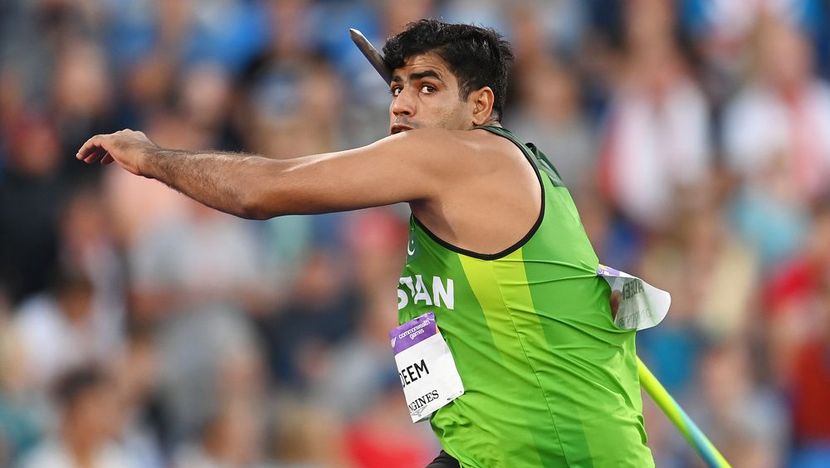
Field events show their own distinct pattern. The javelin, discus and hammer records have moved more recently, with several dating from Gold Coast 2018 and Birmingham 2022, driven in part by the emergence of outstanding individual throwers. Arshad Nadeem threw 90.18m in Birmingham to set the javelin record. However, the pole vault men's record belongs to Steve Hooker from Melbourne 2006, the triple jump men's record to Jonathan Edwards from Manchester 2002 and the shot put women's record to Valerie Adams from Delhi 2010. Field events resist the constant churn seen in swimming because progression depends less on entire systems improving together and more on the arrival of singular athletes capable of redefining an event.
Part of what the records reveal is the remarkable breadth of the Commonwealth itself. Swimming and track cycling are shaped heavily by funding, facilities and technology, which is why the same nations often dominate record progression across decades. Athletics is different. Kenya's sustained excellence in distance running shows that dominance can emerge through culture, environment and tradition as much as formal systems. But even that kind of depth does not explain everything. Singular athletes such as Bayi or Thompson produced performances that resisted not just one generation of challengers but several, in events where no lasting national dominance followed in their wake.
What the records also reveal is how much the Games themselves have changed. Many older Commonwealth records were set over imperial distances before metric standardisation arrived in 1966. Others belong to discontinued relay formats and obsolete weight categories that no longer exist in modern competition. Some records survived because they were extraordinary. Others survived because the sport itself changed shape around them.
The result is a records book with two very different textures. In some disciplines it reads like a rolling update, with marks falling almost on schedule every four years. In others it feels like a time capsule, names and times from another era still sitting quietly while the sport around them changed entirely.
Those contrasts are not simply statistics. They chart the changing shape of Commonwealth sport: which disciplines transformed rapidly, which barely moved and which performances have outlasted every generation that followed.
